
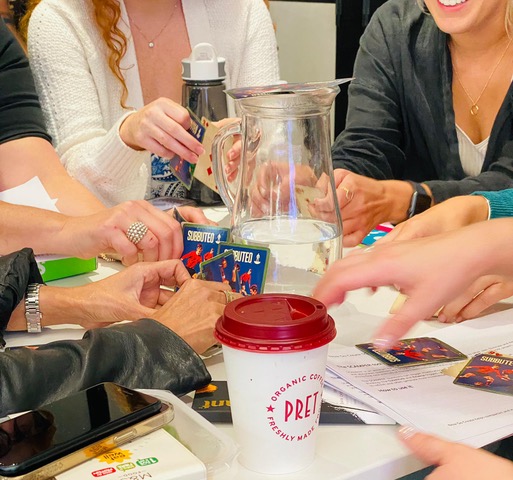
A practical check-in on how your team really thinks together
Something I’ve observed from working with thousands of people, and hundreds of teams is that a lot of the time teams don’t struggle because they lack ideas. They often struggle because the conditions for good thinking erode, or are never in place to start with.
Maybe:
- A lack of strategy or direction means that your team is a group of individuals following their own ‘North Star.’
- Poor facilitation skills mean that the loudest voices prevail in meetings or brainstorms without making room for introspection or reflection, leaving anyone who has a more internal process feeling underutilised and ignored.
- The team has no shared understanding of what great creative output looks like in your context meaning subjectivity rules the roost.
- Things are so fast-paced, that the lure of tried and tested beats original thinking every time but leaves you all with the feeling you know you could have done better.
Every team is different and what are barriers for your group will be different from others. So, I’ve put together a mini-audit for teams to identify what helps and what gets in the way of your team doing its best thinking together.
You can do this as:
- an individual reflection, then compare notes
- or a shared conversation in a meeting or workshop
Take it one section at a time.
1. What ‘good creative work’ actually looks like on this team
Start here.
- When has this team done work it was genuinely proud of?
- What made that work ‘good’ – what criteria are you using to define your creative output?
- What behaviours were present?
- What was noticeably absent?
- Can you identify any other factors that make the difference to the team’s creative output?
2. Speaking up
Ask yourself (ves) honestly:
- Can people suggest barely or half-formed ideas without apologising or feeling judged?
- Is disagreement treated as useful or uncomfortable?
- Do quieter voices tend to disappear?
- Do the people running team stand ups or brainstorms understand facilitation methods?
Teams need permission to think out loud without worrying about the consequences. It’t not about ‘there are no wrong or rubbish ideas’ – there will be loads. It just that we’ll treat them as initial ‘material’ not an assessment of the person’s entire personality or abilities.
3. How ideas move through the team
Map the real flow, not the ideal one.
- Where and how do ideas start?
- Where and how do they get shaped and developed?
- Where do they get stuck, watered down, or killed?
- Is it genuinely a team effort or is it the same people and the same places?
- Do you play to the team’s different strengths and preferences? Do you even know what they are? See the next section.
If ideas routinely die in the same place, that’s potentially a system issue not an ideas problem.
4. Strengths in the room
Every team has different thinking strengths, whether they name them, or share them, or not.
- Who seeks clarity?
- Who spots gaps or risks?
- Who pushes for originality?
- Who keeps things moving?
- Who dissents?
- Who brings insights?
- Who loves the wider picture?
- Who digs detail
If the same people are always expected to ‘be creative’ in the same way, you’re underusing the room.
5. The shadow side of those strengths
This is where teams get interesting.
- When does clarity become over-simplification?
- When does originality tip into impracticality?
- When does efficiency override time to think?
- When does the desire for group harmony suppress unconventional thought?
Creative friction is healthy.
Unexamined friction is a wasted opportunity.
6. Decision-making and ownership
Creative teams stall when decisions are fuzzy.
- Who decides what moves forward?
- How often are decisions reopened without explanation?
Creativity suffers when effort doesn’t feel proportionate to influence.
7. Energy and pace
Look beyond output.
- When does the team feel most alive?
- When does energy consistently dip?
- Are you asking for creative thinking when people are already drained?
Every day creativity beats heroic bursts every time.
8. Language and habits
Notice the phrases that shape behaviour:
- “We don’t have time”
- “Let’s be realistic”
- “That won’t fly”
- “We tried that before”
Language creates invisible rules.
Once you hear them, you can choose which ones to keep.
9. Rituals (or lack of them)
Every team has rituals even accidental ones.
- How do you start projects?
- How do you review work?
- How do you close things down?
- How do you acknowledge progress or learning?
- How do you celebrate your creative achievements?
10. One thing to change
Don’t try to fix everything.
As a team, agree on:
- one condition to improve
- one habit to test
- or one ritual to introduce
Make it small. Make it visible. Review it and review it again.
If you want help developing your team’s creative capabilities get in touch with me claire@nowgocreate.co.uk