
How to Stop Groupthink Killing Creative Thinking at Work
Like much of the nation, I’ve become slightly obsessed with The Traitors. It’s gripping TV – tense, dramatic, and often infuriating.
But beyond the entertainment, the Round Table, the central place where decision making takes place has started to feel uncomfortably familiar.
Because if you strip away the cloaks and candlelight, what you’re really watching is a bad meeting.
Or more specifically: a bad brainstorm.
The Round Table: genius TV, terrible thinking
From a format perspective, the Round Table is brilliant. From a thinking perspective, it’s a car crash.
What gets banished isn’t just players – it’s original ideas, nuance and critical thinking.
If you’ve ever sat in a meeting where:
– one confident voice set the direction
– silence was mistaken for agreement
– challenging the group felt risky
– decisions happened fast but didn’t feel right
…then you’ve already been at the Round Table.
Why brainstorms fail: the psychology of groupthink
What’s playing out in The Traitors is a textbook example of groupthink.
Groupthink happens when a group values agreement or harmony more than critical thinking. The result is that decisions are made quickly, confidently – and often badly.
Every ingredient for groupthink is baked into the Round Table, and into many workplace meetings too:
– high stakes
– time pressure
– incomplete information
– strong personalities
– social consequences for dissent
Sound familiar?
“The loudest idea wins”
At the Round Table, the first confident accusation often sets the tone.
Once a name is floated:
– people start looking for evidence to support it
– contradictory information is ignored
– silence is interpreted as guilt
– disagreement feels dangerous
The same thing happens in badly run brainstorms.
When the most senior or confident person speaks first:
– the group converges too early
– alternative ideas never surface
– quieter thinkers opt out
– confidence is mistaken for clarity
Creativity doesn’t die with a bang. It quietly exits through the fire door.
What’s missing from many brainstorms: managed divergence and convergence
Good creative thinking follows a natural rhythm:
Diverge → explore → converge
That means generating multiple possibilities, holding ideas lightly, resisting early judgement, and only then deciding.
The Round Table skips straight to judgement.
Rarely is anyone asking:
– what else could be true?
– what are three alternative explanations?
– if this theory is wrong, what might we be missing?
Instead, certainty arrives early and crowds everything else out.
Silence doesn’t mean agreement
One of the most damaging myths in meetings is that silence equals buy-in.
In reality, silence can mean:
– someone needs time to think
– someone doesn’t feel safe disagreeing
– someone has been drowned out before
– someone has learned it’s career-limiting to speak up
Earlier in my career, I was often the “go with the flow” person because it felt safer. I’ve also experienced how being the dissenting voice can be emotionally – and professionally – punishing in the wrong environment.
I see the same dynamic now when I’m facilitating. Reputational risk outweighs idea quality, hierarchy rules, and groups default to the safest option.
Three ways to stop your brainstorm becoming a Round Table
If you want better ideas, you don’t need louder voices. You need better conditions.
1. Separate thinking from speaking
Give people time to think or write before anyone talks. This prevents the first idea from hijacking the room and surfaces stronger thinking from quieter contributors.
2. Protect disagreement early
Make it explicit that alternative views are welcome before consensus forms. Once alignment hardens, challenging it feels socially expensive.
3. Delay judgement on purpose
If you move straight to decisions, you’re not brainstorming – you’re voting. Build in a deliberate divergence phase where multiple ideas or explanations are actively encouraged.
Why this matters for creativity at work
Creativity isn’t about wild ideas or blue-sky thinking. It’s about creating the conditions where better thinking can happen.
When meetings reward speed, certainty and confidence over curiosity, diversity of thought collapses. Innovation slows, even in smart and experienced teams.
The irony is that the most dangerous decisions often feel the most unanimous.
Banishing “who shouts loudest” brainstorms
The Traitors works because it exposes how persuasive certainty can be, even when it’s wrong.
At work, we don’t get the dramatic reveal. We just live with the consequences.
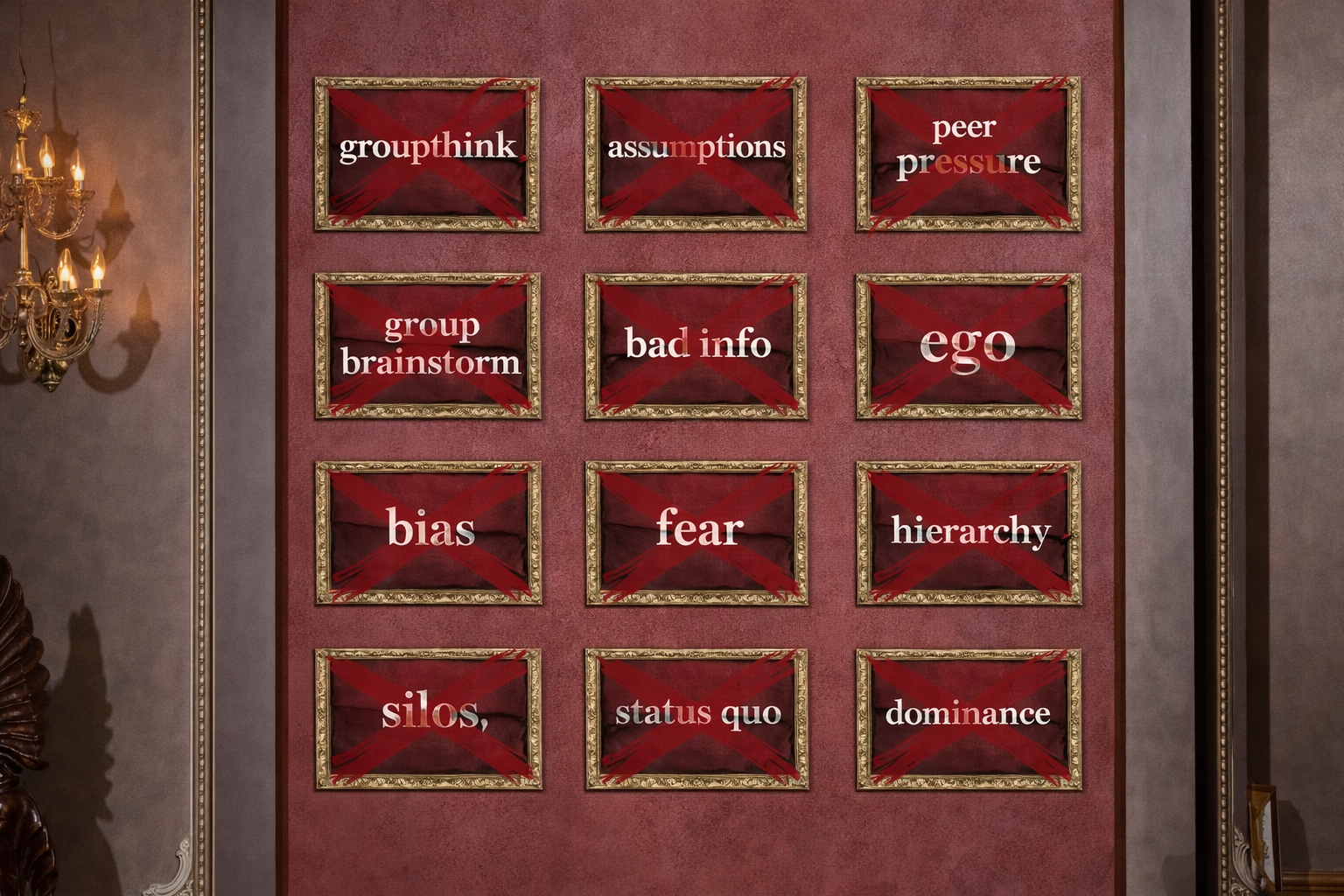
If nothing else, it’s worth agreeing to banish brainstorms where hierarchy dominates, assumptions go unchallenged, speed is valued over insight, and the loudest idea always wins.
Good thinking needs openness, friction and time.
Not a Round Table.
Want help building better creative thinking at work?
I’m Claire Bridges, Founder of Now Go Create. I help individuals, teams and organisations develop their creative capabilities through training, workshops and consulting – especially in environments where groupthink, hierarchy and fear get in the way of good ideas.