
Lessons from using Dr Max McKeown’s quick start strategy
In short: When I was asked to act as a critical friend on a communications strategy with too much data, an undefined audience and hard-to-measure outcomes, I used Dr Max McKeown’s one-page Quick Start Strategy template to cut through it. The biggest lesson? Vagueness is the enemy of strategy, and the most useful thing a framework can do is force you to surface your assumptions so you can work around them honestly.
What does it mean to be a “critical friend” on a strategy?
A critical friend is someone brought in to review a piece of work with fresh eyes. You’re on the team’s side, but your job is to ask the questions they might be too close to ask themselves. It’s supportive challenge rather than criticism.
This week I was asked to play that role for an organisation’s comms strategy. Which sounds lovely, until you open the accompanying folder.
The problem: too much information, not enough clarity
There was a mountain of background material. Data from multiple sources. Segmentation borrowed from outside the organisation. Internal audience studies that were past their usefulness date. Each source was useful on its own, but together they pointed in slightly different directions.
This is a really common situation in comms and marketing. Organisations rarely suffer from a lack of information. They suffer from a lack of a clear way to make sense of it.
As a reviewer, it’s easy to get pulled into the detail and come back with feedback that amounts to “there’s a lot here” as well “there’s a lot missing”. That isn’t helpful to anyone. I needed a structure.
What is Max McKeown’s quick start strategy?
Dr Max McKeown is a strategy author and adviser, perhaps best known for The Strategy Book. His Quick Start Strategy is a one-page template designed to help you get to the heart of a strategic challenge quickly, without building a hundred-slide deck first.
The beauty of it is the constraint. One page means you can’t include everything. You have to decide what matters.
How I used the one-page template to review the strategy
I used the template as a sorting tool. Rather than reading everything and trying to hold it all in my head, I asked where each piece of information belonged on the page, and what it told us about the core questions of any strategy: where are we now, and where do we want to be?
Very quickly, that exposed where the real difficulties were.
The audience wasn’t clearly defined. With external segmentation and out-of-date internal studies, there was no single, confident answer to “who are we trying to reach?”
The outcomes were hard to measure. Without clear measures of success, it was difficult to describe “where we want to be” in anything other than general terms.
So when we tried to fill in “where we are” and “where we want to be”, we could only do it broadly. That in itself was a valuable finding.
Why vagueness is the enemy of strategy
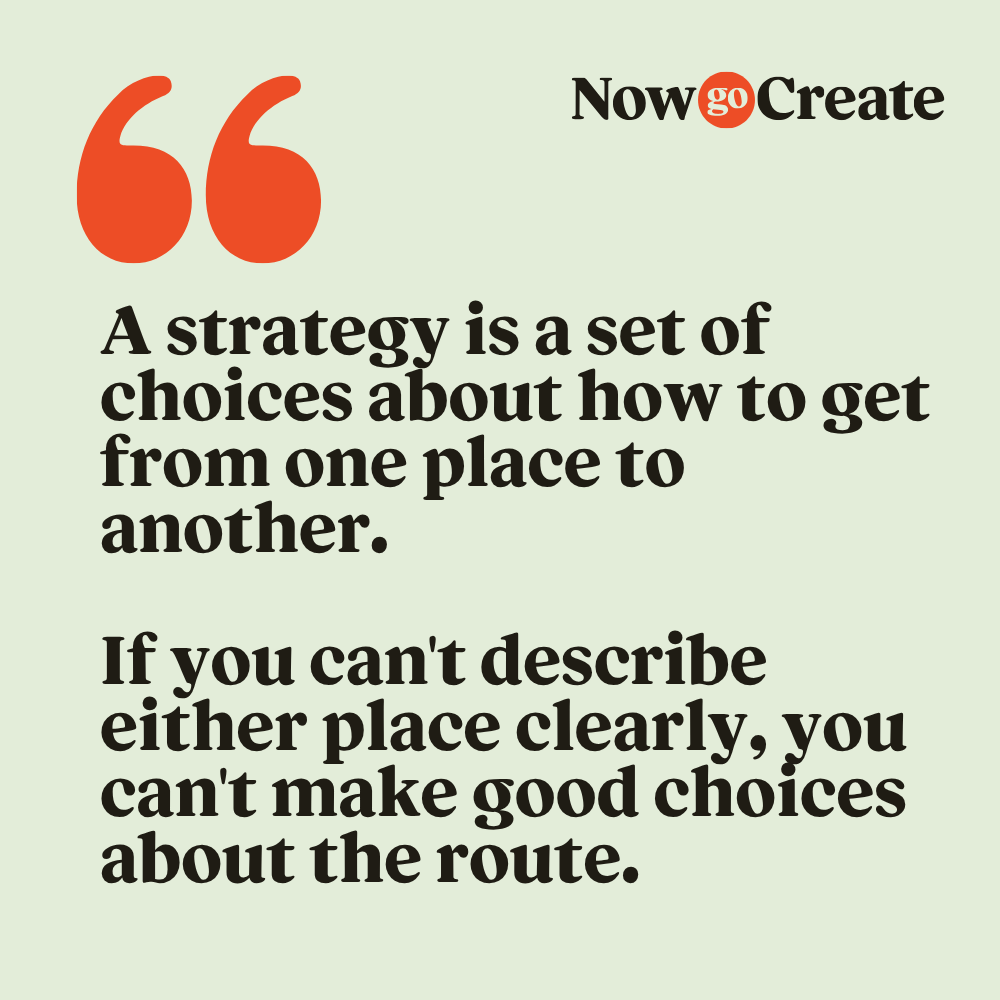
A strategy is a set of choices about how to get from one place to another. If you can’t describe either place clearly, you can’t make good choices about the route.
Vagueness makes diagnosis hard. If the audience is fuzzy, you can’t tell whether the messages will land. If the outcomes are fuzzy, you can’t tell whether the plan is working, or even what “working” would look like. Everything becomes a matter of opinion, and strategy discussions turn into debates about taste.
The danger is that teams paper over this. They write confident-sounding objectives on top of shaky foundations, and the uncertainty never gets talked about.
Surfacing assumptions: how to work with an unclear brief
What the framework gave us wasn’t a perfect answer but it was an honest one.
Because the gaps were visible on the page, we could name them. We wrote down our assumptions explicitly: who we believed the audience was and what we want them to think, and do, what we thought success would look like, which pieces of data we were trusting and which we weren’t.
Once assumptions are written down useful things happen:
- You can test them. Some assumptions can be checked quickly with a conversation or a small piece of research.
- You can design around them. Where you can’t resolve an assumption yet, you can build the strategy so it holds up if you’re wrong, or so it helps you find out.
- Everyone is working from the same page. Literally. Disagreements become visible and discussable, rather than hiding inside different interpretations of the same vague objective.
That shift made the conversation sharper and my feedback far more useful. Instead of “this feels unclear”, I could say “this part of the strategy rests on this assumption, and here’s how we might reduce the risk”.
Why I love frameworks (and my test for a good one)
I teach creative and strategic thinking frameworks every day. But my test for any framework isn’t how good it looks on a workshop slide. It’s whether I can pick it up on a busy week, with a messy real-world problem in front of me, and have it genuinely help.
The proof is in the pudding. Max McKeown’s Quick Start Strategy passed.
A good framework does three things:
- It gives you somewhere to put everything, so you stop drowning in detail.
- It exposes the gaps, so you can see what you don’t know.
- It creates a shared language, so a team can have a better conversation.
- Of course it can’t replace your research and thinking but it can help order and share them.
Key takeaways
If you’re reviewing a strategy, or writing one, and the brief is vague:
- Force the information onto one page before you do anything else.
- Be honest about how clearly you can describe “where we are” and “where we want to be”.
- Treat an undefined audience and unmeasurable outcomes as findings, not failures.
- Write your assumptions down, then test them or design around them.
- Remember that clarity is a choice. Vagueness is usually a sign that a decision hasn’t been made yet.
If you want help upskillking your team in strategy, contact claire@nowgocreate.co.uk